Leave 3CX or Twiliowithout downtime.
We move phone systems off per-seat and per-minute platforms onto open-source telephony you own, with the switch planned so callers never notice.


01Who it is for
The problems we are usually called about.
Businesses on 3CX, Twilio or another per-seat or per-minute platform, who want to own their telephony without risking a day of missed calls.
Price rises you cannot avoid
Licensing changes arrive and there is no alternative ready.
Paying by the minute at scale
Usage-based pricing that suited a small operation is now a large line in the budget.
Features locked behind higher tiers
The capability exists, but only in a more expensive plan.
A switch that feels too risky
Phones are critical, so the move keeps being postponed.
02What we do
A planned move, not a leap.
Audit
Every number, call flow, integration and recording on the current system listed.
Build
The new system built and tested alongside the old one.
Porting and parallel running
Numbers moved in stages while both systems are live.
Cutover and support
The switch made out of hours, with engineers on hand afterwards.
03How it runs
Step by step.
- 01
Scoping call
We learn what you run, what it costs and what you depend on.
- 02
Audit
Every number, call flow, integration and recording is listed.
- 03
Build alongside
The new system is built and tested while the old one keeps working.
- 04
Port in stages
Numbers move in groups, with both systems live.
- 05
Switch and settle
The final cutover happens out of hours, with engineers on hand.
04What you get
Delivered, documented, yours.
The same call flows, or better
Nothing lost in translation.
A cost comparison
What you paid before against what you pay now.
A way back
Until you are satisfied the new system is right.
Tools we work with
Your stack, not ours
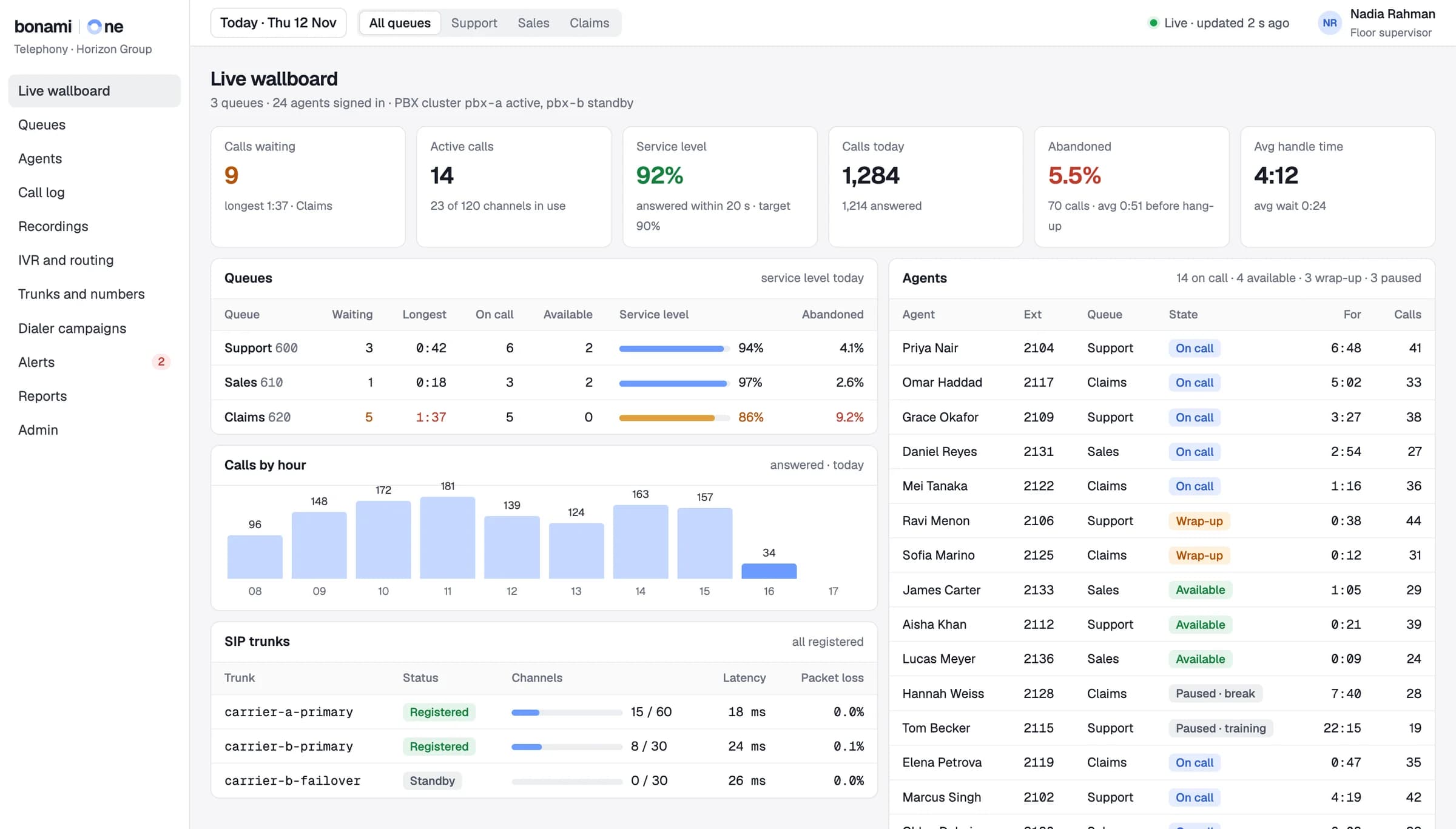
Example build
Call-center wallboard
Queues, agents and SIP trunks on one live screen for floor supervisors, driven by Asterisk queue and channel events.
Questions
What clients ask first.
Will we miss calls during the move?
The plan is built so you do not. Both systems run together, numbers move in stages and the final switch is made at a quiet time.
Can we keep our existing phones?
In most cases, yes.
What about applications built on Twilio?
We look at each one. Some are rebuilt on Asterisk, some stay where they are, and we tell you which makes sense.
Can we go back if it does not work?
Yes. The old system stays available until you are satisfied.
How much will we save?
It depends on your seats and usage. We give you a comparison based on your own bills.
How long does a migration take?
It depends on the number of users, numbers and integrations. Most of the time is spent building and testing alongside your current system, so your daily operation is unaffected until the planned switch. You get a written timeline after the scoping call.
Tell us what you run.
Thirty minutes with an engineer. You leave with a clear scope, a timeline and a recommended approach.