Automation with AIwhere it helps.
We automate the routine hand-offs between your systems and people, and use AI only for the steps that need judgement.
01Who it is for
The problems we are usually called about.
Operations leaders whose processes cross several systems and depend on people copying information from one to the next.
Work that waits in inboxes
A request sits until someone has time to move it to the next system.
Copy and paste between systems
The same details are typed into the CRM, the ERP and a spreadsheet.
Automations that failed quietly
A script stopped working months ago and nobody noticed.
Steps that need judgement
Classic automation stalls wherever a person has to read and decide.
02What we do
Fewer hand-offs, same control.
Process mapping
How the work really flows today, and where the time goes.
Integration
Your CRM, ERP, helpdesk and email connected so data moves without retyping.
Human approvals
People kept in the loop at the points that carry risk.
Monitoring
Failures surfaced and retried, not silently dropped.
03How it runs
Step by step.
- 01
Scoping call
We choose a process and walk through how it really runs today.
- 02
Map and measure
Each step, hand-off and delay is recorded, so we know where the time goes.
- 03
Design
We decide which steps to automate, which need AI and which stay with a person.
- 04
Build and connect
Integrations are built against your systems and tested with real cases.
- 05
Run and monitor
The workflow goes live with alerts on failure and reporting on time saved.
04What you get
Delivered, documented, yours.
Automations in production
Running on your infrastructure.
Time saved, measured
Against how long the process took before.
Documentation
So your team can change the workflow later.
Tools we work with
Your stack, not ours
From our work
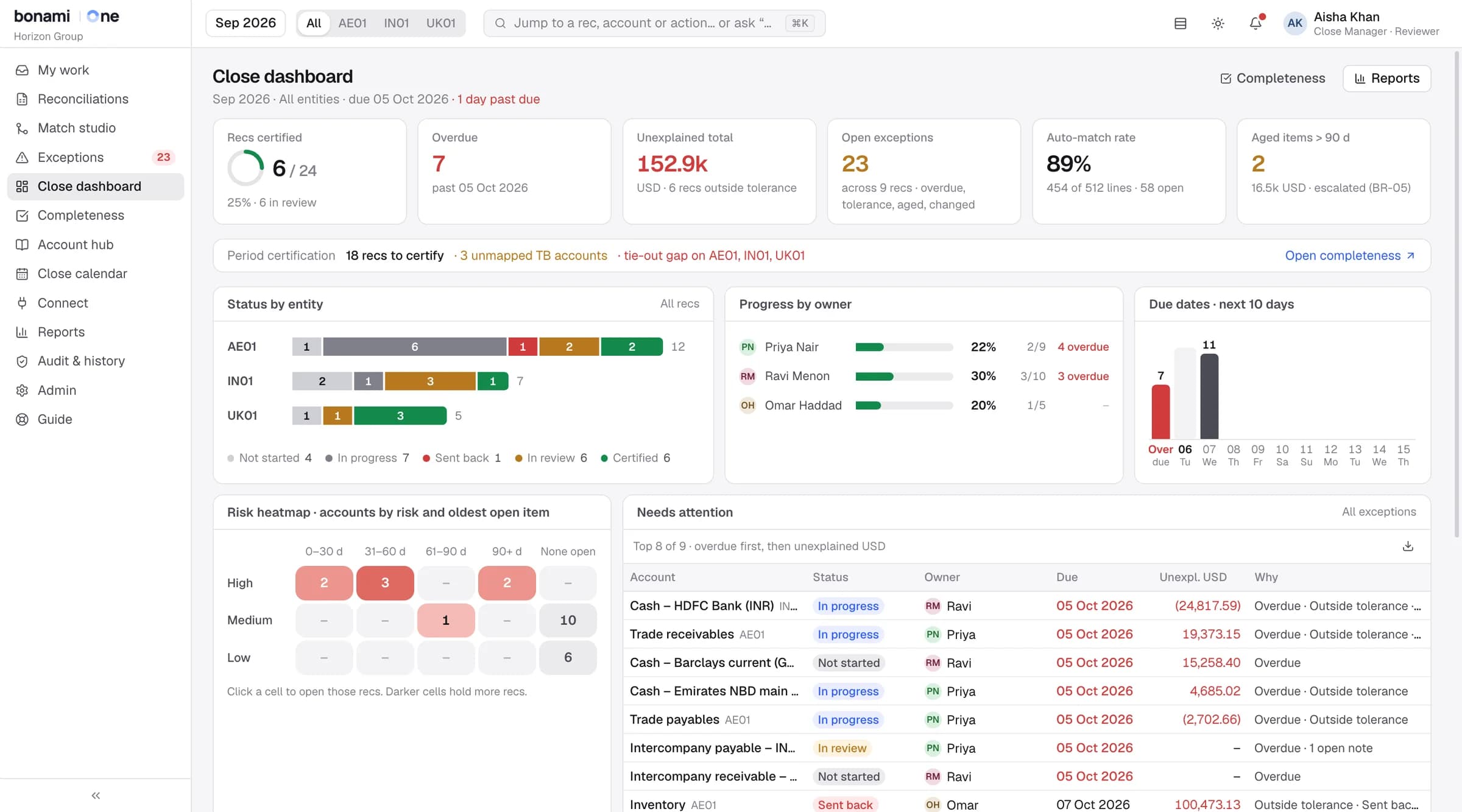
Account reconciliation platform
A month-end reconciliation platform for a finance team moving off spreadsheets. AI proposes the transaction matches; people review and sign off.
Questions
What clients ask first.
Where do you use AI, and where not?
AI is for steps that involve reading or deciding, such as classifying a request. Moving data between systems is done with ordinary, predictable integration.
What happens when something fails?
Failures are caught, retried where sensible and raised to a named person. Nothing is silently dropped.
Do people lose oversight?
No. Approval steps are placed wherever a decision carries risk, and every run is logged.
Can our team change the workflow later?
Yes. It is documented and built so that someone other than us can maintain it.
How do you measure the benefit?
We record how long the process took before, and report the same measure afterwards.
Do we need to replace any of our systems?
No. Automation connects what you already run. If a system has no usable interface we tell you early and suggest the least disruptive way around it, which is sometimes a small change on your side and sometimes a different approach to that one step.
Tell us what you run.
Thirty minutes with an engineer. You leave with a clear scope, a timeline and a recommended approach.