Data pipelinesthat hold.
We build and run the pipelines that move data from your systems into one place, tested and monitored so the numbers arrive right and on time.

01Who it is for
The problems we are usually called about.
Finance, operations and analytics teams whose reports depend on data from several systems, and the engineering leads who are asked to keep it flowing.
Reports that disagree
The same number comes out differently depending on who built the query.
Pipelines that break quietly
A source changes, a job fails overnight, and nobody knows until a director asks why the dashboard is empty.
Analysts doing plumbing
Skilled people spend their week exporting, cleaning and joining files by hand.
A bill that keeps climbing
Compute and storage costs grow faster than the value the data produces.
02What we do
From source systems to trusted tables.
Ingestion
Data brought in from your SaaS tools, databases, files and event streams.
Transformation and modelling
Raw data shaped into clear, documented tables your analysts can use.
Orchestration and monitoring
Scheduled runs, data tests and alerts, so problems are caught before a report is wrong.
Cost control
Compute and storage tuned so the bill grows more slowly than the data.
Documentation as we build
Every table, job and dependency described, so the next engineer does not have to read the code to understand it.
03How it runs
Step by step.
- 01
Scoping call
We look at your sources, the decisions the data has to support and what is already in place.
- 02
Source assessment
Each system is profiled for volume, quality and how it can be read, so the plan rests on what is really there.
- 03
First pipeline in production
We take one valuable source end to end, with tests and monitoring, so you see the standard before we scale it.
- 04
Roll out the rest
Remaining sources follow the same pattern, with a demo on your infrastructure every week.
- 05
Handover or support
Your team takes it over with documentation and runbooks, or we keep running it on a support plan.
04What you get
Delivered, documented, yours.
Pipelines your team can run
Code in your repository, with documentation and runbooks.
One agreed definition of each table
Named, described and owned, so two analysts asking the same question get the same answer.
Tests on the data itself
Checks for freshness, completeness and broken logic on every run.
A clean handover
Or a support plan, if you would rather we keep it running.
Tools we work with
Your stack, not ours
From our work
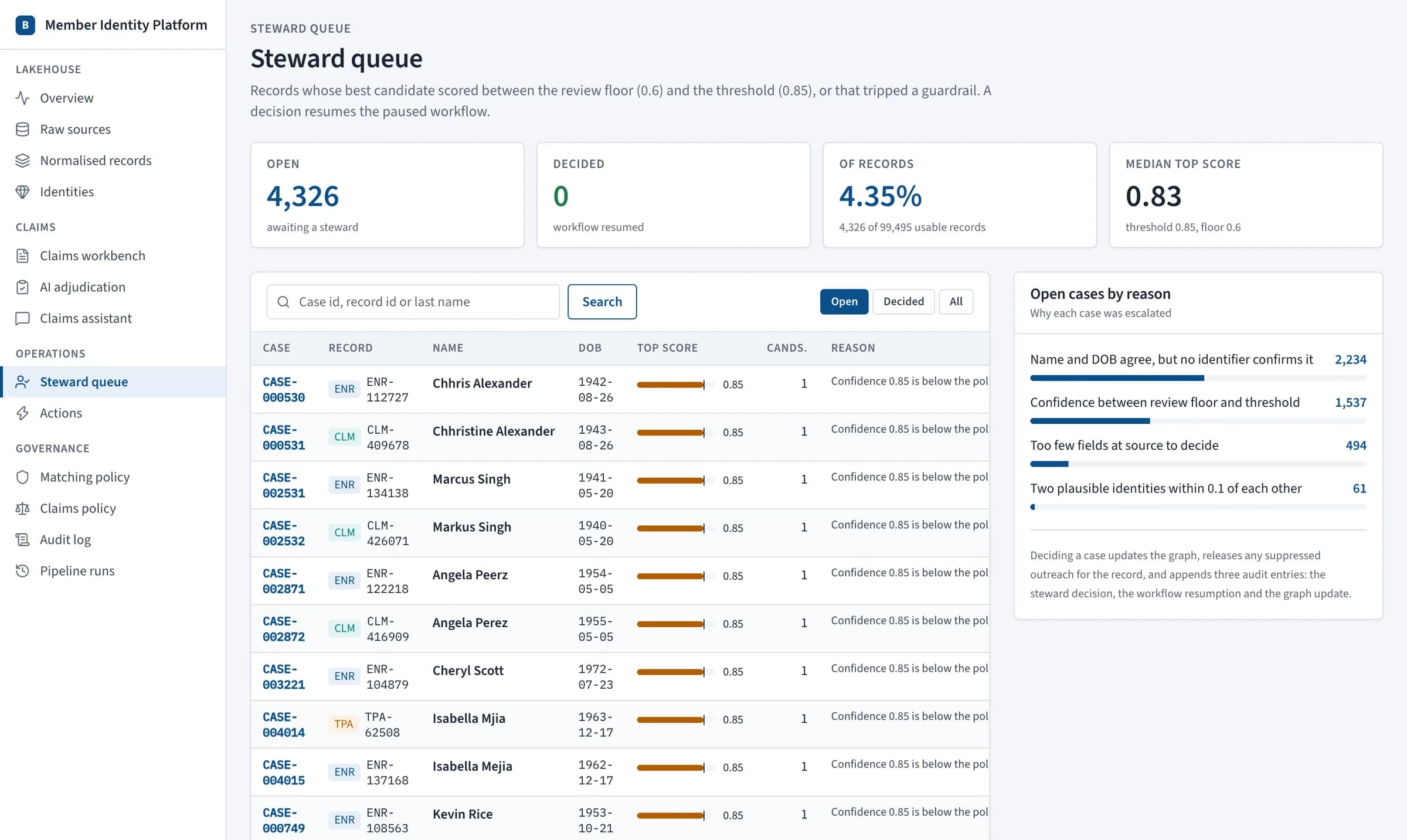
Member identity resolution
We matched 100,000 health-insurance member records from enrolment, claims and third-party files into single identities. Uncertain matches go to a reviewer, and every decision is logged.
Questions
What clients ask first.
Do you work in our cloud account?
Yes. We build inside your environment, in your repositories and your cloud. Your data does not leave it.
Which platform should we be on?
It depends on your workloads, your team and what you already own. We work across Databricks, Snowflake and Microsoft Fabric and will tell you plainly if a simpler option fits.
Can you take over pipelines someone else built?
Yes. We start by documenting and testing what exists, fix what is fragile, and only rebuild where it is cheaper than repairing.
How long does it take?
It depends on the number of sources and the state of the data. After the scoping call you get a written scope with a fixed timeline and price.
Do you use AI to write our pipelines?
Yes, under control. Our engineers use Claude Code through commercial API access inside your environment, and every change is reviewed by a person and passes tests before it is merged.
What happens after handover?
You own the code, documentation and runbooks. Many clients keep us on a support retainer for monitoring and changes, but nothing depends on it.
Tell us what you run.
Thirty minutes with an engineer. You leave with a clear scope, a timeline and a recommended approach.