Forecasts yourplanners will use.
We build demand, churn and capacity forecasts that planners trust, because they can see how accurate they are.

01Who it is for
The problems we are usually called about.
Planners in supply chain, operations, finance and customer teams who need a number for next week or next quarter and need to know how far to trust it.
Forecasts built in spreadsheets
They take days to produce, depend on one person and are out of date when finished.
Too much stock, or too little
Money tied up in the wrong products while the right ones run out.
Customers leaving without warning
By the time churn shows in the figures, it is too late to act.
Forecasts nobody believes
Planners override them because nobody has shown how accurate they are.
02What we do
Predictions with their error bars.
Demand forecasting
By product, location and week, with seasonality and promotions accounted for.
Churn prediction
Which customers are likely to leave, early enough to act.
Inventory and staffing
Forecasts turned into stock levels and rotas.
Accuracy reporting
Each forecast compared with what happened, and with your current method.
03How it runs
Step by step.
- 01
Scoping call
We agree what is being forecast, at what level of detail and how far ahead.
- 02
Data and baseline
History is assembled and your current method is measured, so there is a fair comparison.
- 03
Model and test
Models are tested on past periods they have not seen, and compared with the baseline.
- 04
Deliver into planning
Forecasts arrive in the system or spreadsheet your planners already use.
- 05
Track accuracy
Every forecast is compared with what happened, and the model is refreshed as patterns change.
04What you get
Delivered, documented, yours.
Forecasts in the tools you plan in
Delivered to your planning system or spreadsheet, not a separate portal.
A clear accuracy record
So people know how far to rely on each number.
Models your team can rerun
With documentation.
Tools we work with
Your stack, not ours
From our work
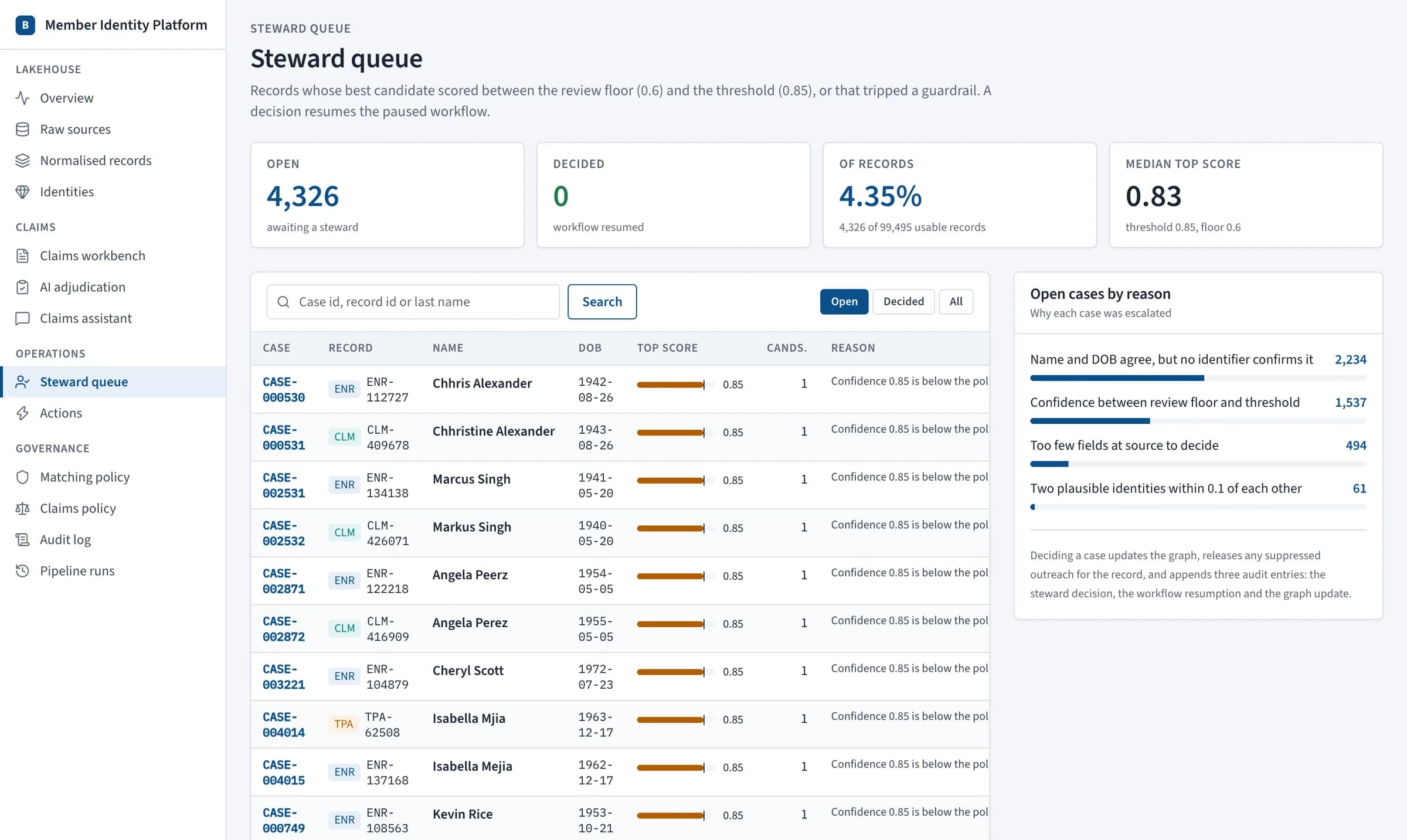
Member identity resolution
We matched 100,000 health-insurance member records from enrolment, claims and third-party files into single identities. Uncertain matches go to a reviewer, and every decision is logged.
Questions
What clients ask first.
How accurate will it be?
We measure that on your own history before you rely on it, and show the result next to your current method so the improvement is plain.
Can it handle promotions and seasonality?
Yes. Holidays, promotions, price changes and other known events are built in as inputs.
What about new products with no history?
We use similar products and early sales to forecast them, and are clear about the wider uncertainty.
Will planners be able to override it?
Yes. People stay in charge. Overrides are recorded so you can see whether they help.
How often is it updated?
As often as the decision needs: daily, weekly or monthly, on a schedule that runs without manual work.
Tell us what you run.
Thirty minutes with an engineer. You leave with a clear scope, a timeline and a recommended approach.