Machine learning thatreaches production.
We take models from an idea to something your business runs on, and we say so when a simpler method would do the job.

01Who it is for
The problems we are usually called about.
Teams with a prediction or optimisation problem worth solving, and a history of models that never left a notebook.
Models that never ship
A promising analysis was done, presented, and then nothing changed in how the business runs.
Decisions made on instinct
Experienced people decide well, but not consistently, and their knowledge does not scale.
A model nobody maintains
It worked when it was built. Nobody knows whether it still does.
Uncertainty about whether ML is needed
It is not obvious whether the problem needs machine learning or a few good rules.
02What we do
From a question to a running model.
Problem framing
What decision the model supports, and how we will know it works.
Model development
Built and compared against a simple baseline, on your data.
Deployment
Models served, scheduled and connected to the systems that use them.
Monitoring
Accuracy tracked over time, with retraining when it drifts.
03How it runs
Step by step.
- 01
Scoping call
We agree the decision the model will support and how success will be measured.
- 02
Baseline
We measure how well a simple method does, so any model has something honest to beat.
- 03
Build and compare
Models are developed on your data and judged against the baseline in your own terms.
- 04
Deploy
The model is served, scheduled and connected to the system where the decision is made.
- 05
Monitor and retrain
Accuracy is tracked over time, with retraining when the data drifts.
04What you get
Delivered, documented, yours.
A model in production
Not a notebook.
An honest comparison
Against what you do today, in your own numbers.
Code and documentation
So your team can maintain and retrain it.
Tools we work with
Your stack, not ours
From our work
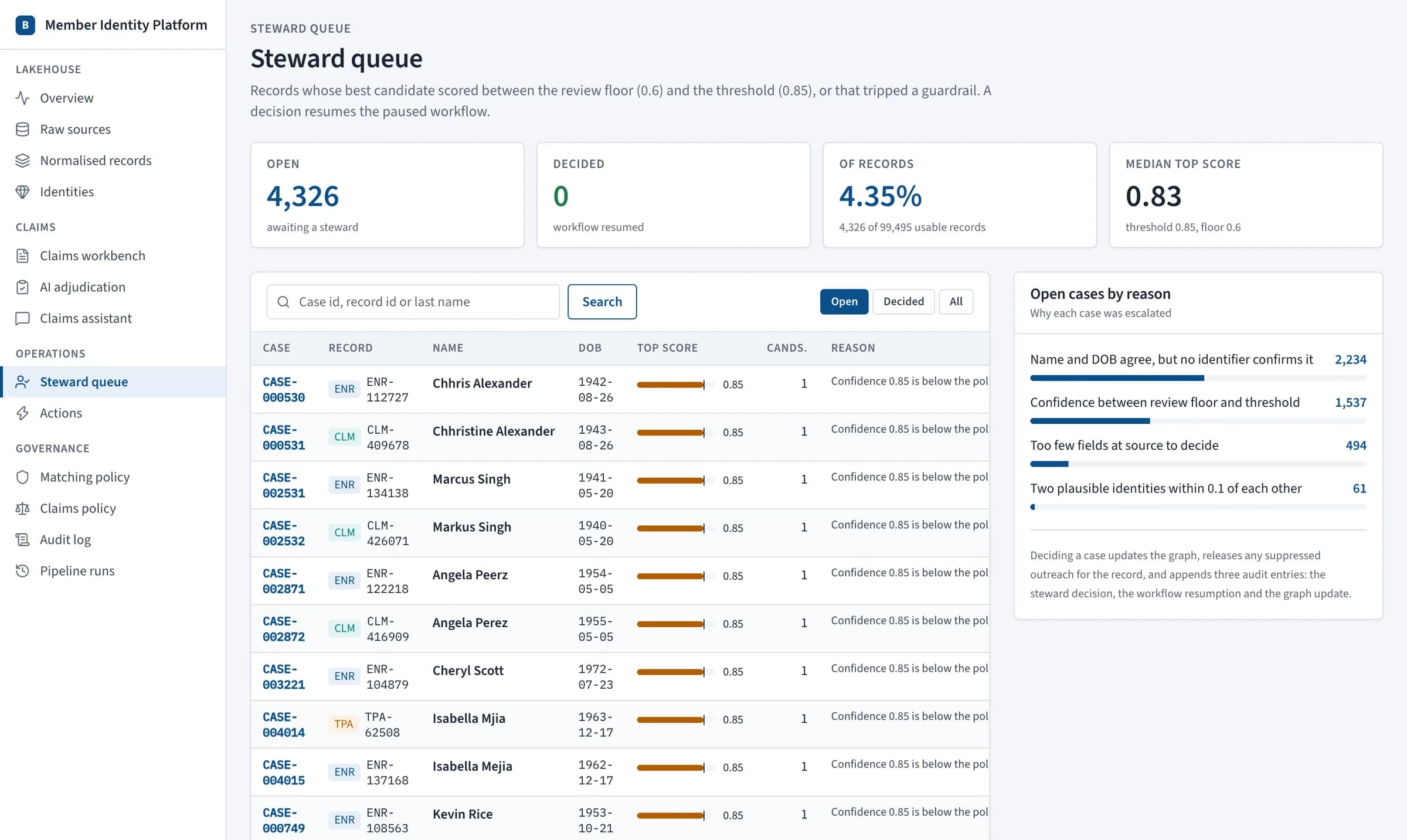
Member identity resolution
We matched 100,000 health-insurance member records from enrolment, claims and third-party files into single identities. Uncertain matches go to a reviewer, and every decision is logged.
Questions
What clients ask first.
Do we have enough data?
We check before you commit. A short feasibility test on a sample usually tells us whether a model is likely to beat what you do today.
What if a model does not help?
We say so. Sometimes a clear rule or a better report is the right answer, and it costs far less to run.
Can our analysts maintain it?
That is the aim. We hand over code, documentation and a retraining process, and train your team on it.
How do you know it still works a year on?
Monitoring compares predictions with outcomes continuously and raises an alert when accuracy falls.
Will our data leave our environment?
No. Models are trained and run inside your own cloud account.
Tell us what you run.
Thirty minutes with an engineer. You leave with a clear scope, a timeline and a recommended approach.